The Virtues of Vision in National and Personal Development – Dr. Nii Moi Thompson
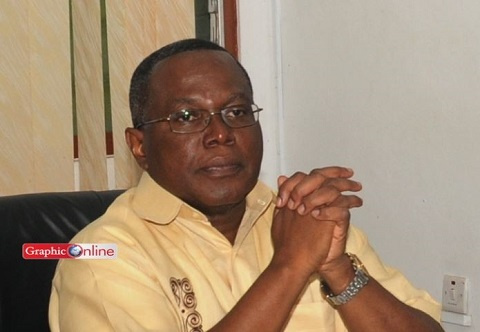
This is a great speech delivered by Dr. Nii Moi Thompson at the 15th Graduation Ceremony African University College of Communications on the 8th December, 2018. It made for great reading and I asked permission to share it with you all.
Today, I’d like to talk about the virtues of vision in national and personal development because of its importance to you as future agents of national development and of course the development of your own lives.
But first I must congratulate the founder, Hon. Kojo Yankah, for having the vision some 16 years ago to set up this institution and to nurse it, by dint of hard work, amidst much trials and tribulations, to this stage of its evolution. From 60 students in 2002, the college, which started as a diploma-awarding institute – and, hopefully, will become a full university in the not-too-distant future – now boasts over 1,400 students – and counting.
I can only wish him luck and pledge my moral support as he navigates the many challenges and frustrations that come with managing success and cementing his place in the history of Ghana and indeed that of Africa and beyond. I see a day when Africans at home and abroad, the wider African diaspora, seized by the Pan-African ideals of the university, will flock to its lecture halls to drink of the fountain of knowledge of self and of the larger African world, past, present and the future.
I also wish to the thank the faculty, staff, the Governing Council, parents, neighbours, friends, and students for the support that they have provided in various ways to Mr Yankah as he gives of himself to his motherland and humanity.
I must also thank him for choosing me to speak at such a historic event. For the parents and guardians who have been paying school fees over the years, this occasion represents potential financial relief and at the same time a source of pride that your children and wards have accomplished what few others often do, that your labour has finally borne fruit. For the students, too, the joy of graduation is tempered with the uncertainties of life that await you as you go out in search of jobs, and, once you find any, settle down to raise families and work in various ways towards the development of this dear country of ours.
Traditionally, graduation or commencement speeches are about sharing with graduates your reflections on life and its many lessons and what, if any, they can learn from them.
One of the biggest lessons that life has taught me – both at the personal level and within the context of national development – is the importance of having a vision, either as an individual, an organisation, or a country, and doing everything necessary and possible to realise that vision.
As the Bible says, where there is no vision, the people perish – and even if they don’t perish literarily, they are bound to suffer somehow for the folly of not having a vision, of choosing to drift through life, aimlessly, hopelessly, endlessly.
And what better way to plunge into a discussion of vision than to use the experience of the founder, Mr. Yankah, long before he even became a founder, when he was minister of the Central Region some 20-plus years ago.
As regional minister, he anticipated the region’s economic and population growth and the need to improve transportation there. He thus got a private company to conduct a feasibility study for constructing an airport in Cape Coast, the regional capital. He didn’t end there. He also got another company to agree to build the airport on its own, recover its cost over 20 years, and hand the airport over to the government – Build, Operate, and Transfer (BOT).
A brilliant example of visionary leadership, you would say, except that his superiors in Accra didn’t think so; they refused to see the need for an airport, visionless as they were, telling him that it was not a national development priority. At the time, the population of the Central Region was just over one million; today, it’s about 2.5 million. The dream of positioning the region for the demands of the 21st century was killed off in the stuffy and visionless corridors of power in Accra.
Anyone who has travelled the Accra-Cape Coast route lately and had to endure the unnerving traffic would attest to the wisdom of Mr. Yankah’s decision, two decades ago, to build the airport. Indeed, I dare suggest that the economy of the Central Region has suffered greatly as a result of the refusal to build the airport, which would have alleviated much of the overland traffic. Conference tourism in the Central Region, which once benefitted greatly from businesses in Accra, has now all but ground to a halt.
This is what happens when a people lack vision, or at least reject it when it is offered to them: they may not perish, but they surely will pay a high price in the form of arrested development, and with that high levels of unemployment, poverty, inequality, and even crime.
And what is true for a region is no less so for a country, as we have seen since our independence.
In 1962, five years after independence, Ghana had a per capita income that was 73% higher than that of South Korea. Today, Ghana’s per capita income is not only lower than South Korea’s but it is only 5% of it; indeed, South Korea now gives Ghana foreign aid – a crying shame, if ever there was one.
We must ask ourselves why, and how? The answer is rather simple: One country had a vision, the other didn’t. Need I tell you which one did, and which didn’t?
To be fair, we did in fact have a vision in the years immediately following independence, but we abandoned it after the 1966 coup. The importance of a vision and its associated long-term or long-range planning was eloquently stated in the famous Seven-Year Development Plan of 1963/64 to 1969/70 as follows:
The economic policies to be realised under this and successive plans of economic development will lack direction and consistency unless they are firmly related to a clear vision of the structure of the economy towards which we are moving. Besides, it is only in the longer view that it is rational to project any really radical transformation of an economic system.
In the very short period we remain prisoners of our past. The most important factors which determine the level of a country’s economic development are not subject to radical change in a short period. The structure of production and trade, the location of manpower and economic activity, the skills and age characteristics of the labour force, the technological level of the community – all these can only change over a period.
However, the direction and the speed of such change can be influenced by positive policy: And if it is left to chance, the economy stagnates or develops in the wrong direction. The long run objectives of Ghana’s policy in economic and social development can, therefore, be attained in a relatively short period of calendar time if the arrangements made from time to time are properly designed to speed up economic change along the chosen lines….
Government believes that a long-run or perspective plan for Ghana’s economic development must have four principal objectives:
(i) The economy must be developed so as to be able to assure to every Ghanaian who is willing to work employment at a high level of productivity and a rising standard of living.
(ii) The colonial structure of production based on exports of primary commodities which largely accounts for the present low level of income must be completely altered.
(iii) The new structure of production that takes its place must be so designed as to enable Ghana to play her full part in a Pan-African, or at least a West African, economic community.
Perhaps, the most poignant piece of advice in this excerpt from the Seven-Year Development Plan is the risk of being “prisoners of our past” if we didn’t take a long-term view of our national development. And indeed, we have been just that since 1966 – prisoners of our past.
In the decade and a half following the coup, we watched as a once-promising economy gradually disintegrated amidst a corrosive comedy of military adventurism and political instability. From purported governments of “liberation” in the 1960s to those of “redemption” and “revolution” in the 70s, Ghana steadily descended into the pits of hell. Basic household items such as soap, bread, sugar, and milk became so scarce that to have them was to be somebody, know somebody who knew somebody who would sell you some items under cover of darkness, lest the soldiers got wind of it and punished you. Companies that once manufactured a range of products from matches, shoes, corned beef, radio sets, mattresses, to even cars, folded up one after the other as the economy imploded.
The country also suffered from an exodus of the very people it needed for national development. As many as 15,000 trained teachers were said to have left the country within a decade, with an even higher number of health and other professionals joining in.
The result was the abandonment and neglect of educational and health facilities and indeed the overall bureaucracy for managing national development. Pupil teachers, many with hardly any education, stepped in to fill the void, with a predictable decline in the quality of education that has persisted till this day. Our hospitals, once described as being among the best in Africa, became instead, in the words of one commentator, places for death rather than health.
The early 1980s brought us stabilisation and economic recovery programmes, supported and financed by the IMF and the World Bank, to restore the health of the economy. Growth soon turned positive for the first time in years, but it later became clear that we needed more than a recovery to positive growth; we needed a road map, a long-term plan, or a national vision, no matter how imperfect, to guide short- and medium-term policies.
Thus was born a document called Vision 2020 in 1996 with the objective of transforming Ghana into a middle-income country by the year 2020. But becoming a middle-income country was to be just the one aspect of a much wider and deeper process of economic and social transformation that would include substantial reduction in poverty and inequality as well as improvements in the provision of such essential social services as health, education, housing, and transportation, among others.
But Vision 2020 was abandoned in 2001 and replaced with a series of medium-term plans that, though well-meaning, lacked strategic direction, or an overall vision of where Ghana wanted to be in the long run. These were the Ghana Poverty Reduction Strategy (GPRS I) and the Growth and Poverty Reduction Strategy (GPRS II), both of which were required by the IMF and the World Bank as a precondition for debt relief.
Debt relief did provide, well, some relief all right, in terms of stability of the cedi, for example, because our external debt service payments were substantially reduced and per capita income did grow steadily afterwards.
But the fundamental problems of the economy, such as low savings rates, high inflation, and high interest rates, all of which impeded broad-based and jobs-intensive growth, remained and kept growth below its potential; by 2007, the economy was in crisis again. In 2010, through some statistical sleight of hand called rebasing of the Gross Domestic Product (GDP), Ghana declared itself a lower middle-income country but without the associated improvements in overall socio-economic conditions.
Poverty remained endemic, especially (and paradoxically) among food crop and cash crop farmers, who represented the poorest socio-economic group in the country. The percentage of the population with access to sanitation remained unacceptably low at just 13.3% compared to the average of 47.3% for lower middle-income countries. Over 80% of Ghanaian workers had no more than a BECE education, and nearly 30% had no education at all.
We were thus a middle-income country only in name; for all practical purposes, we were and remain a low-income country. Indeed, the latest report on poverty released in August 2018 found that the number of poor people in Ghana increased by about 400,000 between 2012/2013 and 2016/2017, with the rural areas accounting for more than 80% of the incidence of poverty in the country. Indeed, in the rural savannah, the poverty rate, which had declined from 64.2% in 2005/2006 to 55.0% in 2012/2013, shot up to 67.7% in 2016/2017, making them worse off than they were a decade earlier. Not surprisingly, inequality also increased nationally, especially in rural areas.
In short, Ghana has massively under-performed relative to its potential at independence. Indeed, had it maintained the same income ratio with South Korea as it did in 1962, Ghana’s per capita income today would be over $45,000, among the highest in the world, instead of the $1,000-$1,700 that it has had in recent years.
Ghanaians were concerned enough about this state of affairs that when the Constitution Review Commission in 2010 engaged the public on ideas for transforming our constitution from a political to a developmental one, there were overwhelming calls for a long-term national development plan – in order to ensure consistency in development policy and continuity across governments. In 2011, Parliament, deliberating on the best ways to spend expected oil revenue, also asked for the development of a long-term national development plan to guide development policies and programmes.
Thus it was that in 2015, the National Development Planning Commission, where I was director-general, commenced the process of preparing a long-term national development plan that would be binding on all successive governments but flexible enough to allow each to pursue policies specific to their party’s manifesto or the exigencies of the time.
The vision of this plan was nothing short of ambitious: To transform Ghana into a high-income country by the time it celebrates its 100th independence anniversary, with high levels of economic, social, environmental and institutional development befitting a high-income country. The plan would cover the period 2018 to 2057, which would be 40 years, not 39, and it would be divided into 10 four-year plans that would overlap with the election cycle, giving every government the chance to play its role.
To be able to measure progress towards this admittedly ambitious vision, the plan set the following five strategic goals:
- Build an industrialised, inclusive, and resilient economy
- Create an equitable, healthy and prosperous society
- Build well-planned and safe communities while protecting the natural environment
- Build effective, efficient, and dynamic institutions for national development, and
- Strengthen Ghana’s role in international affairs
These goals, similar to the Millennium Development Goals or the Sustainable Development Goals of the United Nations, are to be pursued by successive governments through policies and strategies of their own choosing; progress is to be measured through carefully chosen indicators and targets. Under Goal One, for example, we envisioned a steady growth in Ghana’s economy from $42.9 billion in 2016 to $3.6 trillion in 2057, which should translate into per capita income of $58,401 in 2057, up from $1,515 in 2016.
For some, this was “too ambitious”, but if we must develop and transform as we want, with the population growing and expectations rising, nothing can be too ambitious. As Marcus Garvey used to say, What others have done, we can do. And if the Koreans did it, why not Ghanaians?
Yet others complained – rightly and wrongly, yes, wrongly – that the 40-year timeframe was “too long”, that we needed to focus on issues of today and somehow let the future take care of itself.
Besides the fact that such a view of national development is selfish, focusing as it does on the here and now at the expense of the wellbeing of future generations, it tends to ignore the importance of having a vision in national development.
In this case, it is not about what we are to do in 40 years’ time, but what must be done now – in 2018, 2019, 2020 and so forth – to lay a foundation for the building of the high-income country we envision, while at the same time taking care of our contemporary needs. It’s as much a struggle for the present as it is for the future; they are not mutually exclusive.
For example, becoming a high-income country requires a world-class education system in all respects. In this regard, the plan recommends 100% net enrolment rate for primary school by the year 2021, not 2057; for kindergarten it is to be by 2025; and for junior high school and senior high school by 2029, mindful of the current state of education at each stage and the investments required to meet these targets; where feasible, the targets may be attained sooner than proposed. This is what we fought for independence for – to dream big and accomplish big things, not cower in the shadow of our potential.
Ambitious targets are also set for 100% trained teachers in our all schools between 2021 and 2029, adequate textbooks for every student, from KG to high school, and a radical revision and transformation of curriculums to accord with the needs of the 21st century. Such revision and transformation will help deal with the problem of outdated textbooks and lecture notes that lead to the “dead knowledge” that we fill our children’s heads only for them to graduate and find a world that is markedly different from what they learnt in school. There are even targets to ensure that every school in the country will have potable drinking water and modern toilet facilities by 2021.
Is this what some call “too ambitious”? If anything, it is not ambitious enough! The idea of building schools for children without installing toilets and other basic facilities for sanitation is not only unconscionable but even criminal – that we should put children in such a difficult position on a daily basis. But we have done it and tolerated for so long that we consider it normal; well, not anymore, according to the long-term plan.
Similar targets are set for the health sector, the economy, infrastructure, human settlements, governance, and of course strengthening Ghana’s role in international affairs.
Even more important is the issue of unemployment and how best to combat it now and in the future as the nature of the economy changes and the sources of employment change with it. Hence, for the present, the plan proposes a three-pronged strategy to stimulate (1) labour demand (through high, broad and consistent rates of economic growth), (2) labour supply (through 21st century education and training programmes), and (3) labour markets (ensuring that those who are employed are paid well in line with their skills and their work).
Twenty-five strategic growth areas, ranging from those requiring low skills to those that will require some of the best-educated workers in the world, are also proposed.
And then there is a whole section called the Future of Work, which should interest you as fresh graduates. This section proposes strategies for job creation and decent work in the future as robotics and artificial intelligence compete with human labour in the workplace. When that happens, we may have to ration jobs and have multiple shifts, possibly even four, as the only way to create enough employment and avoid the social tensions that come with high and persistent unemployment. You should be interested in such visionary thinking – for yourselves and certainly for your children.
We must also confront and accept the fact that whether we plan for it or not, 40 years will come, just as the sun will rise tomorrow, no matter how indifferent we may be towards it today. We are better off planning for it rather than stumbling into it the way we did with Ghana@50 in 2007. At the time, only 12.7% of Ghanaians had access to modern sanitation (after 50 years of independence), a figure that has increased to only 15% since then. We ought to be ashamed of ourselves!
But here are some basic facts also to allay your fears over the figure “40”.
- Forty years is only 10 elections from 2020, with the 10th election being held in 2056, and so it is not the eternity that some people think it is.
- In fact, in 2016, the last generation of Ghanaians who would be 40 years in 2056 and thus qualify to field a presidential candidate in that year were born. There were slightly more than 600,000 of them. The president of Ghana in 2057, therefore, is perhaps sleeping peacefully on her mother’s back somewhere in Ghana as I speak, oblivious, of course, of the history that awaits her in 40 years. Of course, every one of you graduating at 22 years today will be 61 years in 2056. You may very well be sitting next to the president of Ghana in 2057 as I speak! The future is already here, people.
We cannot take our development for granted. The fact that we repeatedly talk about “development” and hold elections every 4 years is no guarantee that there will be development. It is likely that Ghana in 2057 will be poorer than it is today. Examples of others countries abound. Haiti, said to be the poorest country in the Western Hemisphere, is over 200 years old. Liberia, right next door and designated a “least developed country”, turned 171 years old this year. Most of the “developing countries” in Latin America, that are riven with poverty and crime, are about 200 years old or slightly more. The only way to avoid suffering a fate similar to those of these countries is to construct in our minds and hearts the future of prosperity that we desire and work assiduously to make it happen.
That’s what the long-term plan, popularly known as the 40-year plan, is all about: Envisioning a desired future and building it, one step at a time, confident that what others have done we can also do.
Will government embrace and adopt the long-term plan? I don’t know. I certainly hope it does, because, frankly, as a country, we have no choice – it is the only way to make up for lost ground and create an even better future for our children and future generations with any degree of certainty and consistency.
Whatever the case, plan or no plan, you will have a role to play in the development of this country. The question is how would you do it?
The first lesson to take with you is that the world owes you nothing; you owe the world everything – your knowledge, your skills, your toils, your sweat, your aspirations, even our frustrations, your everything. Don’t go out there with a sense of entitlement; you will fail and fail miserably.
Be the change that you desire. Make your time here on earth count. Don’t go out there blaming witches, especially the mothers who gave you life, for your own human frailties and failings. The days of spirits and witches should long be gone. We now live in the age of science and technology. Apply them to solving everyday problems and stop blaming others for your mistakes.
Challenge conventional wisdom, where necessary. Don’t follow blindly. Ask questions over and over again until you have the right answers. Why, for instance, do we continue to build streets with open gutter in this day and age, allow the gutters to gather rubbish for 29 days, and then on the 30th day undertake a “clean-up exercise” and pat ourselves on the back? This clearly is madness, and we can’t continue with it much longer. Other examples abound.
We have heard, for instance, that cleanliness is next to godliness. But can anyone here today look at the filth that engulfs us throughout the country and say with a straight face that we are truly a godly nation? I don’t think so. Judging by the filth, one can say without any apology that we are more devilish than godly, the same reason of hypocrisy and double-talk that makes us so corrupt and wicked, despite our daily deafening proclamations of godliness.
We can’t do all the wrong things, violate all the laws of nature that God himself made billions of years ago, and then expect him to come down from his jealous sky to right those wrongs for us. It doesn’t work that way; it never has, and there is no evidence that God will make an exception for us just because we are Ghanaians. He has 7.5 billion other children to worry about. He suffers no fools, and fools we are if we think we can break his laws and get away with it.
If you put garbage in open gutters and it rains heavily, your house may get flooded and both you and your belongings may get washed away. You will die. Simple as that – same law in Ghana as in Uganda and Canada and Japan, and everywhere else on earth. One God, One World, One Law. No more, no less, no exceptions.
We can’t bribe God with a cathedral after we’ve done all the wrong things by flouting his laws and defiling his creation, polluting his land and its rivers, despoiling the forests, and fouling the air, all of which he gave to us for free and charged us to manage and use for our common good. Imagine if our ancestors thousands of years ago had done such damage to the environment. What would be our fate today?
There is, in my view, no greater way to worship God than to respect his creation and his laws. If you make all the joyful noises in church on Sunday, dance your faith away in his name, only to disobey His laws, laws for preserving His creation, then you are no better than the heathen that you look down upon. In fact, that heathen may be more righteous in the eyes of God than you are, for at least he is honest in his beliefs and acts. What about you?
Some of you may also find yourselves in leadership positions. Don’t be taken in by the perks. In Ghana, it’s easy to be deluded as a leader into being a demi-god. You get easily pampered. People want to hold your bag for you or pull up a seat for you. They even want to serve you food or get you water at public events, when you can easily do that yourself because you used to do that long before you became a leader.
Some people become government ministers (or bosses of some kind) and suddenly they can no longer can do simple things like holding their own folders or files. They show up late at public events and then make sure that their body guards follow them with their folders – a disgusting display of power and influence that signifies vanity, perhaps an inferiority complex, that contributes nothing to national development. Be grounded, or, as the Rastafarians say, remain “conscious”. Don’t fall for such vain-glorious antics.
Leadership can also be a lonely experience sometimes. What you as a leader may deem to be the right thing may be viewed by others, particularly those who profit from the status quo, as a threat. You may be criticised, shunned, derided, sabotaged, even threatened sometimes. In all these, let your conscience be your guide. Lead by example. Be strong. Do the right thing. Demonstrate integrity but also be open to others’ ideas, mindful that the buck always stops with you.
If you should find yourself not as a leader but working under someone, respect them but do not follow orders blindly if you know they go against the ethics of the organisation you work for, or even beliefs that you hold dearly. In Ghana, you will get many people complaining bitterly about corruption or something bad about the society, for example, only for them to indulge in the very things they complain about. They always think the problem is with the other person, not them.
Be prepared to rise above all that, above all temptation. Don’t fall for them and then blame the devil. The devil is tired of being blamed for all our foolishness. Be ready to take responsibility for your failures, for inside every failure lie the secrets to success. It doesn’t mean you should fail on purpose; it means simply that failure is not the end of the world, and that it can in fact be the beginning of good things, if you learn from it. Some of the most successful business men and women in the world failed many many times before they eventually found success. They learnt from their failures, rather than blaming others.
Lastly, be reminded that the knowledge you have acquired at AUCC is only the beginning, the foundation, of the knowledge you will need to get by in life and to contribute to national development. The super-structure that you erect on that foundation of knowledge will depend on how diligent you work once you walk out of the gates of this great school.
But remember that you need a vision of where you want to be once you walk out. Don’t walk out and hope that any destination will do; you must be purposeful, clear-eyed, resourceful, and resilient in dealing with any challenges that might arise.
AUCC has done its part. The rest is now up to you.
I wish you luck and congratulate on your graduation.
Go out there and conquer that world.
Ayekoo!!!
This post has already been read 1387 times!
Share this content:




Post Comment