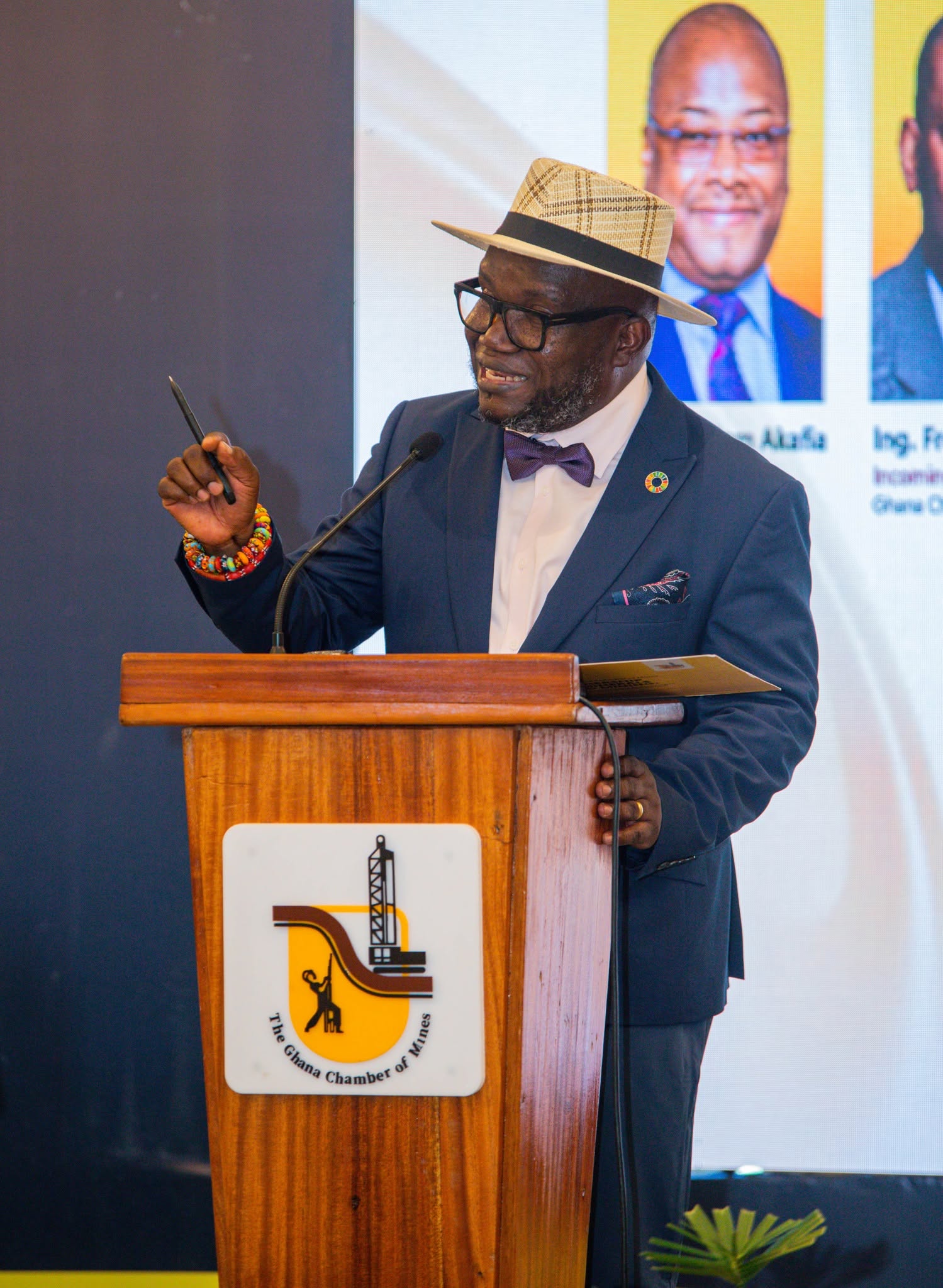
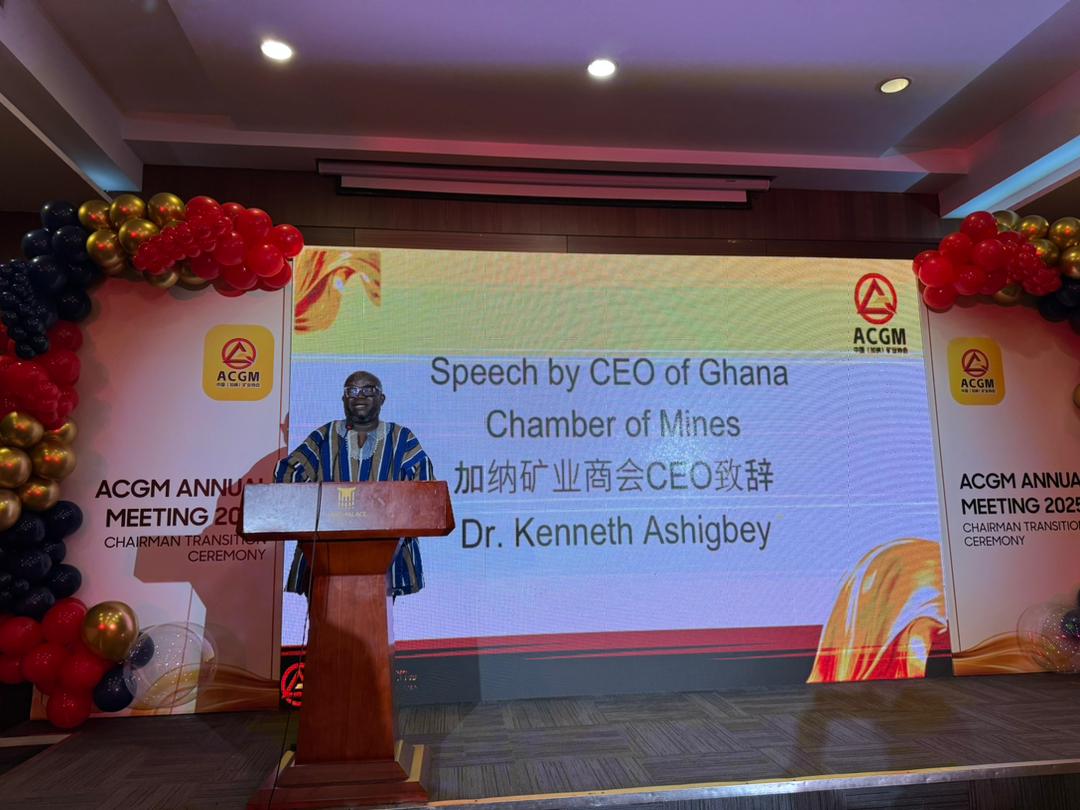
CEO of the Ghana Chamber of Mines Speech at the Made In Ghana Summit 2026

Good morning.
It is both an honour and a privilege to join you today at the Made-in-Ghana Business Summit 2026. Let me begin by congratulating the organisers for choosing a theme that speaks directly to Ghana’s economic future:
“Unlocking Regional Potential: Driving Industrialisation, Youth Entrepreneurship, Job Creation and Made-in-Ghana Prosperity.”
These are not separate ambitions. They are different expressions of one national mission: to transform Ghana from a nation that exports raw materials into one that exports finished products, technology, intellectual property, expertise and globally competitive enterprises.
Today, I stand before you not merely as the Chief Executive Officer of the Ghana Chamber of Mines, but as someone who firmly believes that mining can become one of the engines that powers Ghana’s industrial revolution.
For too long, mining has been viewed simply as an extractive sector—a sector that digs minerals out of the ground and exports them. I believe that view is too narrow. Mining should not simply extract wealth. Mining should manufacture prosperity.
Mining should become the catalyst around which we build industries, create jobs, nurture entrepreneurs, develop technology, transform host communities and build globally competitive Ghanaian companies. That is the future we must pursue.
Mining as the Catalyst for Ghana’s Industrialisation
Ladies and gentlemen,
If we truly want Ghana to industrialise, we must begin by asking a simple question: What industry can generate sufficient demand to stimulate manufacturing across multiple sectors of our economy?
I submit that mining is one of Ghana’s greatest opportunities. Not simply because of the minerals we produce, but because every modern mine is a city of economic activity.
A mine requires steel fabrication, electrical equipment, explosives, chemicals, conveyor systems, engineering services, software, automation, construction materials, machine components, protective equipment, uniforms, catering, transportation, logistics, financial services, environmental management, healthcare, research, innovation and hundreds of other products and services.
Each of these requirements represents an opportunity to build an industry. This is why we must move beyond seeing mining merely as an extractive sector. Mining should become Ghana’s industrial anchor.
Economists describe this through Growth Pole Theory—the idea that one strategic industry, through its backward and forward linkages, can stimulate the development of many other sectors.
Countries do not industrialise by accident. They identify industries with the capacity to create demand across the economy and deliberately build domestic supply chains around them.
Mining offers Ghana exactly that opportunity. It creates demand across manufacturing, construction, transport, ICT, energy, finance, education, research, environmental management, healthcare and hospitality. Every mine creates opportunities for hundreds of suppliers.
The question is:
Who will supply those goods and services?
Will they continue to be imported?
Or will they proudly carry the label Made in Ghana?
Our answer will determine whether mining remains principally an extractive activity or becomes a catalyst for Ghana’s industrial transformation.
The Real Lesson from the California Gold Rush
History provides us with an important lesson. During the California Gold Rush of the nineteenth century, thousands of people rushed west in search of gold. Some became wealthy. Many more lost everything.
Yet some of the greatest and most enduring fortunes were not made by the people who mined the gold. They were made by those who supplied the miners.
Levi Strauss sold durable clothing.
Others manufactured pickaxes and shovels.
Others supplied machinery, food, transportation and financial services.
The gold rush contributed to the development of railways, banking institutions, engineering firms, logistics companies and manufacturing enterprises. Many of these businesses survived long after the gold rush itself had ended.
The miners found gold, but the suppliers built an economy.
That lesson is as relevant to Ghana today as it was to California more than 170 years ago. The greatest opportunity before Ghana is not only to add value to the minerals we produce but also to diversify our economy. It is also to build industries that manufacture everything the mining industry needs.
Steel fabrication.
Explosives.
Engineering equipment.
Mining chemicals, including activated carbon
Protective equipment.
Automation systems.
Digital technologies.
Machine components.
Heavy equipment maintenance.
Environmental services.
Financial services.
Research and innovation.
When we produce these inputs in Ghana, we create businesses that can continue to operate, employ people and export products long after individual mines have closed. That is sustainable industrialisation.
Redefining Local Content: From Trading to Manufacturing
Achieving this requires us to fundamentally rethink what we mean by local content. Our local content policies have produced significant successes. However, the time has come for the next stage of their evolution.
For many years, local content has often been interpreted as creating opportunities for Ghanaian businesses to import foreign-manufactured products and sell them to mining companies.
That creates traders.
It creates distributors.
It creates commercial margins.
But it does not necessarily create industries.
While the importing company may be Ghanaian, the factories, technologies, skills and most of the jobs associated with producing those goods remain overseas. In effect, we may be creating Ghanaian margins while exporting Ghanaian jobs.
The next phase of local content must therefore be different. Local content must become local manufacturing. It must become:
local engineering.
local innovation.
local technology.
local intellectual property.
Local content should no longer be measured primarily by the nationality of the company supplying a product. It should increasingly be measured by where the product was manufactured and where the value was created.
We must ask:
How muchof the product was manufactured in Ghana?
How many Ghanaians were employed in producing it?
How much Ghanaian intellectual property is contained in it?
How much local raw material was used?
How much foreign exchange did it save?
How much export revenue can it generate?
The true objective of local content should not simply be to increase Ghanaian ownership of supply contracts. Its ultimate objective must be to create jobs, build industries, transfer technology and strengthen Ghana’s productive capacity.
This is how we transform local content from margin intermediation into industrialisation.
Instead of importing mining consumables, we should manufacture them.
Instead of importing spare parts, we should engineer them.
Instead of importing every piece of technology, we should increasingly develop our own.
Every factory we establish employs people.
Every machine we manufacture develops technical skills.
Every product we produce locally retains more value within our economy.
That is how industrial nations are built. As Peter Drucker reminded us: “The best way to predict the future is to create it.” Ghana must deliberately create the industrial future it desires.
Ghana Already Has Proof
The encouraging news is that we do not need to imagine what success might look like. We already have examples. Companies such as Zen Petroleum, Gensa, Rabotec, Engineers & Planners, Rocksure International, and many others have demonstrated what is possible when deliberate local content policies meet Ghanaian entrepreneurship.
They began by serving the mining industry. Today, many have become national champions. Zen is listed.
Some operate beyond Ghana’s borders.
Some employ thousands of Ghanaians.
Some are exporting Ghanaian knowledge and expertise across Africa.
These companies did not grow simply because they were protected from competition indefinitely. They grew because mining companies opened opportunities to them, insisted on international standards, supported supplier development and built partnerships that enabled Ghanaian businesses to become more competitive. They are living proof that local content, when designed and implemented well, becomes industrial policy.
Ladies and gentlemen, these are not merely supplier companies. They are evidence that Ghana can build multinational enterprises.
Imagine multiplying these success stories a hundredfold.
Imagine hundreds of Ghanaian companies manufacturing equipment for mines across West Africa.
Imagine Ghanaian engineers designing digital mining solutions used throughout the continent.
Imagine Ghanaian environmental consultants supporting responsible mine closure and land restoration across Africa.
Imagine Made-in-Ghana mining technologies competing successfully in global markets.
That is the opportunity before us.
Industrialising Mining Communities
There is another important dimension to this transformation. Industrialisation should not be confined to Accra, Tema or Kumasi. The communities that host our mineral resources should also host the industries that develop around those resources.
Imagine engineering parks in Tarkwa.
Fabrication centres in Obuasi.
Mining equipment assembly plants in Ahafo.
Explosives manufacturing facilities in the Western North Region.
Technology and innovation hubs serving the mining industry in Bolgatanga.
Machine maintenance and component-rebuilding centres in Bibiani.
These should not merely be isolated factories. They should become industrial clusters where manufacturers, universities, technical institutions, logistics companies, financial institutions and research centres work together.
This is how mining leaves a lasting legacy. Long after the minerals have been extracted, the factories should remain.
The skills should remain.
The technologies should remain.
The businesses should remain.
The employment should remain.
The communities should continue to prosper.
Mining communities must become industrial communities. The location of the mineral resource should become a starting point for broader regional economic development, not merely a site from which wealth is extracted. That is sustainable development.
The 24-Hour Economy Must Power Industrial Growth
Ladies and gentlemen,
Government’s vision for a 24-hour economy presents an exciting opportunity for industrialisation. However, its success will depend on one critical factor: Competitive, reliable and sustainable energy.
Mining is among Ghana’s largest industrial consumers of electricity. Manufacturing is equally energy-intensive. If Ghana is to attract new mineral-processing plants, steel-fabrication factories, equipment manufacturers, engineering industries and technology enterprises, our electricity tariffs must be internationally competitive.
Investors do not compare Ghana only with our immediate neighbours. They compare Ghana with Australia, Canada, Chile, South Africa and, increasingly, Saudi Arabia and other emerging mining and industrial destinations.
Capital flows to jurisdictions where productivity is rewarded, infrastructure is reliable and costs are competitive and policies are predictable. A competitive tariff regime for productive industries is therefore not merely a concession or a subsidy.
It is an investment in exports.
It is an investment in employment.
It is an investment in industrial competitiveness.
It is an investment in the success of the 24-hour economy itself.
The 24-hour economy cannot mean that companies simply operate for longer hours while paying uncompetitive energy costs. It must mean that Ghanaian factories can use their machinery more efficiently, produce at scale, reduce unit costs and compete successfully in African and global markets.
The success of the 24-hour economy will therefore be measured not merely by how long businesses remain open, but by whether Ghana becomes one of the most competitive places in Africa in which to manufacture.
This is why we should commend the 24 Hour Economy Secretariat for their plan to setup a mega solar power generating system to provide reliable and consistent power to Ghanaian industries between 3 to 4 cents per KWh.
Security of Tenure, Investment and Mine Expansion
Ladies and gentlemen,
For mining to serve as an industrial anchor, we must also understand the unique nature of mining investment. Mining differs from many industries because its investment decisions are measured not in months, but in decades.
Before the first ounce of gold is produced, a company may spend many years undertaking geological exploration, resource definition, feasibility studies, environmental assessments, permitting and community engagement.
It then invests hundreds of millions—and sometimes billions—of dollars in roads, power infrastructure, processing plants, tailings facilities, water systems, mining equipment, employee accommodation and community development. A recent example is Newmont Ahafo Mine, that spent $1 billion dollars before the 1st ounce of gold was poured.
These investments are highly capital-intensive. They cannot be recovered over short time horizons. That is why long-term mining leases—often extending for approximately thirty years—are not an extraordinary privilege granted to mining companies. They are an economic necessity arising from the nature of mining itself.
Security of tenure gives investors the confidence that, having committed enormous capital to developing a mineral resource, they will have sufficient time to operate the mine, recover their investment, expand production and continue investing in the communities and industries around it.
Without security of tenure, financing becomes more expensive.
Expansion projects are delayed or abandoned.
New processing plants are not constructed.
Exploration expenditure declines.
Supplier-development programmes become more difficult to sustain.
And capital moves to other jurisdictions offering greater certainty.
We must therefore recognise that long-term leases are not only about protecting investors. They are also about protecting Ghanaian jobs, Ghanaian suppliers, host communities and the long-term industrial opportunities that grow around mining operations.
As posited by my brother Sam Pobee MD of AngloGold and which I use to I often remind policymakers: Capital goes where confidence lives, and confidence lives where policy consistency endures.
If we seek industrialisation, we must provide confidence that extends beyond electoral and political cycles.
Mine Ownership Is Not the Same as Job Creation
This also brings us to an important national conversation about ownership. There is often an assumption that changing who owns a mine will automatically result in the employment of more Ghanaians.
But ownership, by itself, does not create additional jobs. What creates additional employment is investment. What creates new jobs is the expansion of existing mines.
It is the development of new deposits.
It is the construction of additional processing plants.
It is increased exploration.
It is the opening of new pits and underground operations.
It is the establishment of new factories to supply the mines.
A mine operating at the same level of production will not necessarily employ more people simply because its ownership changes. What determines the number of jobs is the scale of operations, the volume of investment, the technology deployed, the strength of local supply chains and the opportunities created for expansion.
Therefore, the more important question is not only: Who owns the mine? We must also ask:
Who is prepared to invest in the mine?
Who will finance its expansion?
Who will extend its life?
Who will develop the next ore body?
Who will build the processing plant?
Who will create opportunities for Ghanaian suppliers, engineers, technicians and young entrepreneurs?
This does not mean ownership is unimportant. Ghanaian participation in mining and across the mining value chain is more important and must continue to grow. But we must not confuse a change in ownership with an automatic increase in employment.
Our priority should be to attract and retain responsible capital—whether Ghanaian, foreign or in partnership—that expands mining operations, develops new resources, creates employment and builds domestic industrial capacity.
The objective must not merely be to transfer ownership of existing assets. It must be to increase Ghanaian participation while expanding the size of the economic opportunity. It must how to extract the over 3 trillion ounces of gold buried in the Ghanaian soil responsibily.
A smaller mine under any ownership structure creates fewer opportunities than a growing mine supported by sustained investment.
Mine expansion creates direct employment. It creates contracts for local businesses. It creates opportunities for manufacturers. It supports the growth of mining communities. It increases exports and national revenues. And it provides the demand around which Ghanaian industrial enterprises can develop.
The policies we adopt must therefore support investment, expansion, foreign and local partnerships and greater Ghanaian participation simultaneously. These objectives are not mutually exclusive. With the right partnerships, they can reinforce one another.
Building Ghanaian Champions for Africa
The next challenge is to help many more Ghanaian companies move from being domestic suppliers to becoming continental industrial champions. How do we achieve this?
First, by creating consistent demand through deliberate local procurement.
Second, by helping Ghanaian firms meet international quality, safety and environmental standards.
Third, by facilitating access to affordable, patient and long-term finance.
Fourth, by investing in research, innovation, technology and skills development.
Fifth, by encouraging partnerships between local firms and experienced international companies for technology transfer and market development.
Sixth, by supporting exports through trade diplomacy and the African Continental Free Trade Area.
Our ambition should be clear. We should not merely produce Ghanaian suppliers. We should produce African industrial champions. Companies that begin by serving mines in Ghana should be supported to provide engineering, construction, environmental, financial, technological and operational services throughout the continent.
AfCFTA Changes Everything
The African Continental Free Trade Area fundamentally changes the scale of our ambition. Our market is no longer limited to Ghana’s population. It is a continental market of more than 1.4 billion people.
With the AfCFTA Secretariat headquartered in Accra, Ghana has a unique opportunity to become a manufacturing and services hub for West Africa and the wider continent.
Why should Ghanaian companies manufacture only for Ghana? Why not manufacture for Mali, Côte d’Ivoire, Burkina Faso, Guinea, Senegal, Democratic Republic of Congo?
Mining is taking place across almost every part of Africa.
Every mine requires equipment.
Every mine requires engineering.
Every mine requires environmental services.
Every mine requires digital technology.
Every mine requires logistics.
Every mine requires skilled people.
There is no reason these products and services cannot increasingly come from Ghana.
Our engineers should work across Africa.
Our manufacturers should export across Africa.
Our software should manage mines across Africa.
Our environmental consultants should restore mining land across Africa.
Our financial institutions should help structure mining transactions across Africa.
Our technical institutions should train mining professionals from across Africa.
AfCFTA transforms Made-in-Ghana from a domestic aspiration into a continental opportunity. The companies that successfully supply Ghana’s mines today can become Africa’s industrial champions tomorrow.
Investing in Young Entrepreneurs
This future ultimately depends on our young people. Across Ghana, thousands of young entrepreneurs possess remarkable ideas. What many lack is not ambition. They lack access.
Access to capital.
Access to markets.
Access to technology.
Access to mentorship.
Access to research facilities.
Access to procurement opportunities.
We must deliberately connect our young innovators to large industrial sectors such as mining. Mining companies should not only publish procurement lists. We should identify industrial challenges that young Ghanaian entrepreneurs, engineers and technology companies can help solve.
Our universities and technical institutions should become centres for developing mining technologies, automation systems, environmental solutions, spare parts and industrial processes.
Our financial institutions must also develop products that recognise the realities of manufacturing. A young entrepreneur who wants to establish a factory cannot be financed on the same short-term basis as someone importing finished goods for immediate resale.
Manufacturing requires patient capital. Innovation requires experimentation. Industrial development requires a willingness to invest before the returns become visible. If we provide our young people with access to markets, finance, technology, mentorship and procurement opportunities, we will create a generation of manufacturers rather than a generation dependent on scarce formal-sector jobs.
That is how nations create lasting prosperity.
Partnership Is the New Competitive Advantage
None of this can happen in isolation. Government must provide stable, transparent and predictable policies.
Industry must deliberately procure locally where capability exists and support local firms to improve their capabilities.
Banks and other financial institutions must finance manufacturing and innovation, rather than concentrating mainly on trading.
Universities must produce graduates with practical industrial skills.
Technical institutions must respond to the needs of industry.
Research institutions must help solve real production and operational problems.
Large companies must mentor smaller enterprises and integrate them into their supply chains.
Mining companies must work with communities to ensure that industrialisation improves local livelihoods.
Government must use diplomacy, trade policy and infrastructure development to help Ghanaian companies enter regional markets.
Industrialisation is not a competition between government and business. It is a partnership. It is also not a competition between Ghanaian capital and foreign capital.
What Ghana needs is responsible investment, effective partnerships, technology transfer and an economic framework that ensures that the benefits of mining are increasingly retained within our country.
As Henry Ford observed: “Coming together is a beginning. Keeping together is progress. Working together is success.”
Conclusion
Ladies and gentlemen,
The future of Ghana will not be determined only by the quantity of gold beneath our soil. It will be determined by the quality of the industries we build above it.
Future generations will not ask only how much gold we exported.
They will ask:
What industries did we create?
What companies did we build?
What technologies did we develop?
What communities did we transform?
What jobs did we create?
What opportunities did we leave behind?
The words Made in Ghana must become more than a label. They must become:
A symbol of innovation.
A symbol of quality.
A symbol of industrial excellence.
A symbol of reliability.
A symbol of African competitiveness.
The Ghana Chamber of Mines remains committed to working with government, industry, academia, financial institutions, entrepreneurs and mining communities to ensure that mining becomes not merely a source of revenue, but the foundation of a diversified industrial economy.
Let us redefine local content.
Let us move from importing to manufacturing.
Let us build manufacturers instead of importers.
Let us create industrial champions instead of trading champions.
Let us transform mining communities into industrial communities.
Let us provide the policy consistency and security of tenure required to attract long-term capital.
Let us recognise that investment and mine expansion—not ownership alone—are what create additional jobs and economic opportunities.
Let us increase Ghanaian participation while continuing to attract the capital, skills and technologies required to expand the industry.
Let us ensure that when history tells the story of Ghana’s mining era, it will not simply record the gold we extracted.
It will celebrate the industries we built. The entrepreneurs we empowered. The technologies we developed. The communities we transformed. The jobs we created. The Ghanaian companies we took into African and global markets. And the prosperity we shared.
Together, let us make Made in Ghana not merely a statement of origin, but a global mark of excellence.
This post has already been read 908 times!
Share this content:








Post Comment