Fussa City Mayoral Election : Lessons for Ghanaian elections (I)
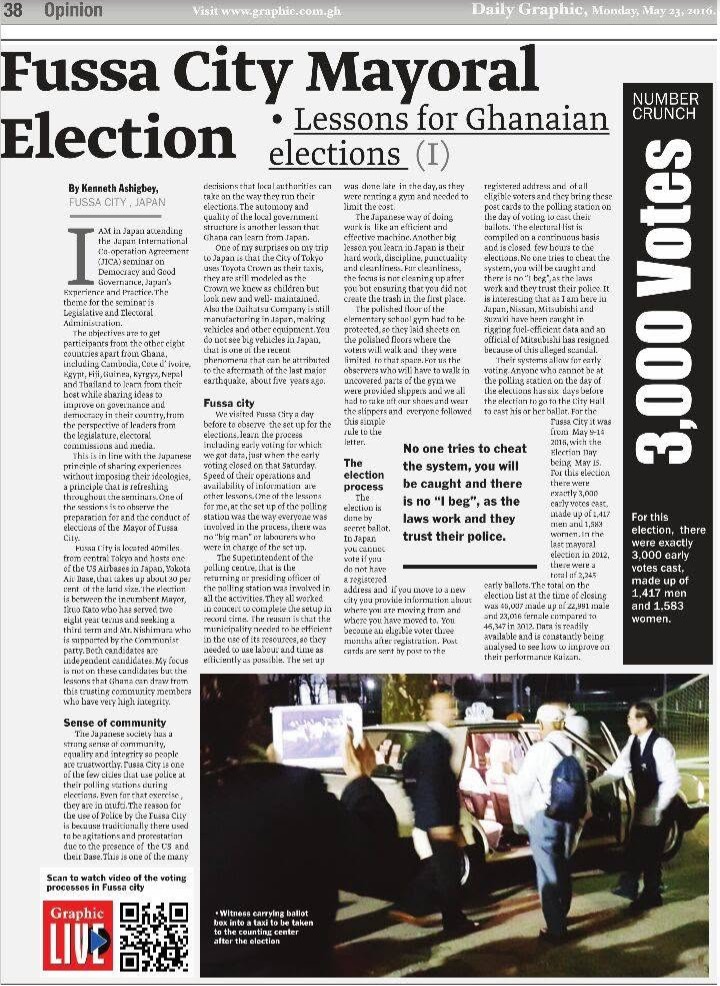
This is one of the few articles I wrote as MD of Graphic Communications Group Ltd. I normally wrote out of anger, frustration, or a desire to fix a challenge. As MD, I wasn’t allowed to call myself Editor-in-Chief, but I took full responsibility for every editorial or content issue. That is a story for another day. This article was written in admiration of the Japanese way of life and governance. I will republish the full text, with a link to the original on GraphicOnline.com. The article was published on 23rd
I am in Japan attending the Japan International Co-operation Agreement (JICA) seminar on Democracy and Good Governance: Japan’s Experience and Practice. The seminar’s theme is Legislative and Electoral Administration.
The objectives are to enable participants from the other eight countries, apart from Ghana, including Cambodia, Côte d’Ivoire, Egypt, Fiji, Guinea, Kyrgyzstan, Nepal and Thailand, to learn from their host while sharing ideas to improve governance and democracy in their countries, from the perspective of leaders from the legislature, electoral commissions and media.
This is in line with the Japanese principle of sharing experiences without imposing their ideologies, a principle that is refreshing throughout the seminars. One session was to observe the preparation for and conduct of the election of the Mayor of Fussa City.
Fussa City is located 40 miles from central Tokyo and hosts one of the US Air Bases in Japan, Yokota Air Base, which takes up about 30 per cent of the land area. The election is between the incumbent Mayor, Ikuo Kato, who has served two eight-year terms and is seeking a third term, and Mr Nishimura, who is supported by the Communist Party. Both candidates are independent candidates. My focus is not on these candidates but on the lessons Ghana can draw from this trusting community, where members have very high integrity.
Sense of community
Japanese society has a strong sense of community, equality and integrity, so people are trustworthy. Fussa City is one of the few cities that use police at their polling stations during elections. Even for that exercise, they are in mufti. The reason for the use of police in Fussa City is that, traditionally, there used to be agitation and protests due to the presence of the US and its base. This is one of the many decisions that local authorities can take on the way they run their elections. The autonomy and quality of the local government structure is another lesson that Ghana can learn from Japan.
One of my surprises on my trip to Japan was that the City of Tokyo uses the Toyota Crown as its taxis; they are still modelled on the Crown we knew as children but look new and well-maintained. Also, the Daihatsu Company is still manufacturing in Japan, making vehicles and other equipment. You do not see big vehicles in Japan; that is one recent phenomenon that can be attributed to the aftermath of the last major earthquake, about five years ago.
Fussa city
We visited Fussa City a day before to observe the setup for the elections and learn the process, including early voting, and we collected data as early voting closed that Saturday. The speed of their operations and availability of information are other lessons. One lesson for me from setting up the polling station was how everyone was involved in the process; there was no “big man” or labourers in charge of the setup.
The Superintendent of the polling centre, that is, the returning or presiding officer of the polling station, was involved in all the activities. They all worked in concert to complete the setup in record time. The reason is that the municipality needed to be efficient with its resources, so they needed to use labour and time as efficiently as possible. The setup was done late in the day because they were renting a gym and needed to limit costs.
The Japanese way of working is like an efficient and effective machine. Another big lesson you learn in Japan is their hard work, discipline, punctuality and cleanliness. For cleanliness, the focus is not on cleaning up after you but on ensuring that you did not create the trash in the first place.
The polished floor of the elementary school gym had to be protected, so they laid sheets on the polished floors where the voters would walk, and they were limited to that space. For us observers, who had to walk on uncovered parts of the gym, we were provided slippers; we all had to take off our shoes and wear the slippers, and everyone followed this simple rule to the letter.
The election process
The election is done by secret ballot. In Japan, you cannot vote if you do not have a registered address, and if you move to a new city, you provide information about where you are moving from and where you have moved to. You become eligible to vote three months after registration. Postcards are sent by post to the registered address of all eligible voters, and they bring these postcards to the polling station on the day of voting to cast their ballots. The electoral list is compiled continuously and closed a few hours before the elections. No one tries to cheat the system; you will be caught, and there is no “I beg”, as the laws work and they trust their police. It is interesting that, as I am here in Japan, Nissan, Mitsubishi and Suzuki have been caught rigging fuel-efficiency data, and an official at Mitsubishi has resigned because of this alleged scandal.
Their systems allow for early voting. Anyone who cannot be at the polling station on election day has six days before the election to go to City Hall to cast their ballot. For Fussa City, it was from May 9 to 14, 2016, with Election Day being May 15. For this election, exactly 3,000 early votes were cast, made up of 1,417 men and 1,583 women. In the last mayoral election in 2012, there were a total of 2,245 early ballots. The total on the election list at the time of closing was 46,007, made up of 22,991 males and 23,016 females, compared to 46,347 in 2012. Data is readily available and is constantly being analysed to improve performance. Kaizan.
This post has already been read 24 times!
Share this content:








Post Comment